
Your Teen Is Confiding in AI. Here’s How to Respond 🤔
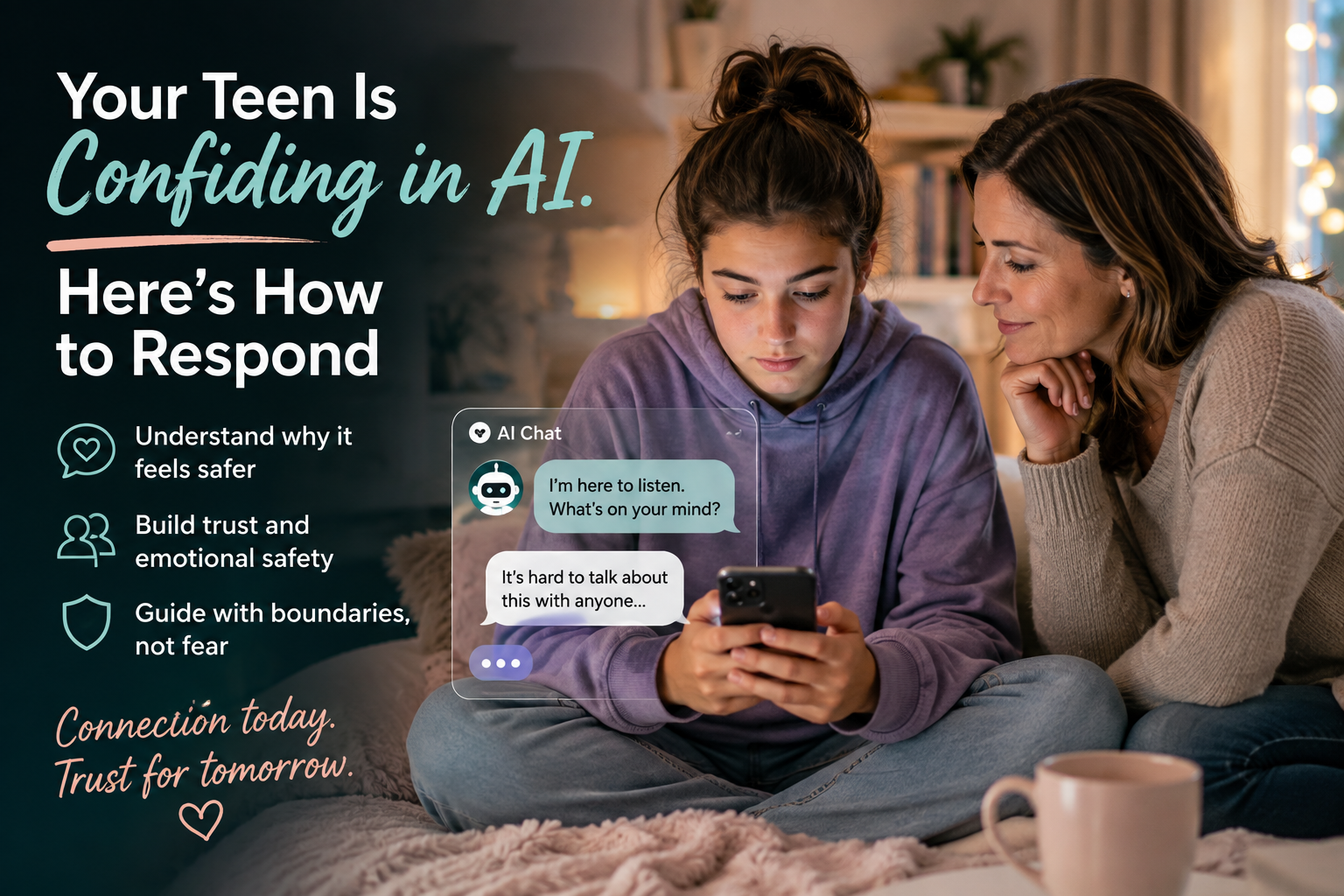
Your teen may be telling AI things they have not told you yet.
That realization can trigger a lot of emotions for a parent. Fear. Guilt. Curiosity. Maybe even the immediate thought:
What did I do wrong?
But a child turning to AI does not automatically mean something is broken in your relationship.
In this episode of Mental Wealth, Katie Halle Lambert and licensed professional counselor Laura Wood talk about why AI can feel like an easy place for kids and teens to ask questions, explore thoughts, and say things they may not feel ready to say out loud.
More importantly, they talk about how parents can respond without accidentally pushing their child further away.
Why Would a Teen Talk to AI Instead of a Parent?
For today's kids, looking for answers online is normal.
They search Google. They watch YouTube. They look things up on social media. Now AI simply adds another option.
The difference is that an AI chatbot can respond conversationally. A simple question can quickly turn into a much deeper discussion.
A teen might start with:
What should I wear on the first day of school?
Then move into:
I'm worried people are going to judge me.
Suddenly, the conversation is not really about clothes anymore. It is about insecurity, belonging, anxiety, or fitting in. That progression can happen naturally.
It Does Not Automatically Mean Your Teen Doesn't Trust You
One of the easiest conclusions for a parent to jump to is:
If they're talking to AI instead of me, I must have failed somehow.
Not necessarily.
As kids get older, wanting more privacy is developmentally normal. There are questions they may feel embarrassed asking anyone. AI can feel easier because there is no awkward facial expression staring back at them.
No immediate judgment. No interruption. No fear of making Mom or Dad panic. That does not mean parents should ignore what is happening. It means curiosity will usually get you further than guilt.
Your First Reaction Matters
Imagine your child finally tells you something difficult.
What happens next?
Do you immediately start problem-solving?
Do you tell them it is "not that big of a deal"?
Do you panic?
Do you start calling teachers, parents, counselors, or the school before your child has finished explaining?
Laura points out that children often pay close attention to a parent's emotional reaction.
If opening up causes Mom or Dad to immediately become overwhelmed, they may decide:
I can't tell them things because they can't handle it.
Sometimes the most helpful first response is incredibly simple.
"Huh."
Then wait. Give them room to keep talking. You do not have to immediately fix the situation.
Try Curiosity Before Advice
Parents naturally want to teach. But every conversation does not have to become a lesson.
Instead of jumping into what your child should have done, try:
"Tell me more."
"What happened next?"
"How did that make you feel?"
"What do you think about it?"
"What would feel helpful right now?"
Your teenager may need understanding before they need advice. And sometimes they simply need to know that you can hear something uncomfortable without falling apart.
Respect Privacy Without Completely Checking Out
Children and teens need growing amounts of privacy. That does not mean parents have to become completely uninvolved in their digital lives.
Laura suggests thinking about oversight based on the child's age, maturity, usage, and individual needs. The goal is not secretly reading every thought your child has shared.
Instead, consider having clear conversations about:
What they use AI for
What information should never be shared online
When you may check their activity
What topics require help from a trusted adult
What technology boundaries exist in your family
Most importantly, do not create hidden surveillance rules. Let your child understand the expectations.
Teach "Internet Hygiene"
Kids need more than screen-time rules. They also need to understand how online tools actually work. Talk about the fact that information shared online may not always be as private as it feels. Help them understand that AI can provide information and conversation, but it is still technology.
It is not a replacement for:
Parents
Trusted adults
Friends
Teachers
Counselors
Healthcare professionals
A healthy goal is not necessarily getting your child to stop using AI. It is making sure AI remains one tool, rather than becoming their only source of support.
When Does AI Use Become Concerning?
The bigger question is not:
"Does my teen use AI?"
It is:
"What role is AI playing in my teen's life?"
Pay attention if your child seems increasingly unable or unwilling to:
Talk with other people
Ask for help
Handle disagreement
Manage normal awkwardness
Interact socially
Solve problems without AI
Spend time away from a chatbot
Frequency matters too. If a chatbot becomes the first and only place your child turns whenever something feels difficult, it may be worth looking more closely at what skills or relationships need strengthening.
Watch for the "Friction-Free" Effect
Human relationships involve friction.
People misunderstand us. They disagree. We occasionally feel embarrassed. Sometimes we say the wrong thing.
Those experiences are uncomfortable, but they are also how social skills develop. AI can feel easier because it often responds calmly and keeps the conversation moving. That is exactly why parents should pay attention to whether a child is beginning to prefer digital conversation over real human interaction.
Kids still need practice navigating actual relationships.
The 15-Minute Connection Challenge
One of Laura's most practical recommendations is also one of the simplest:
Give your child at least 15 minutes of genuine attention every day.
It does not have to happen all at once. Maybe it is five minutes in the kitchen. Three minutes in the car. Seven minutes while they eat cereal.
The important part?
Let them lead.
Do not correct.
Do not turn everything into a lesson.
Do not interrogate.
Just be interested.
That regular attention helps create the kind of connection that makes it easier for a child to eventually bring bigger things to you.
If You Discover Your Teen Has Shared Something Very Personal
Stay calm first. Then consider what the conversation is telling you.
Maybe your teen is embarrassed. Maybe they do not know how to bring the subject up. Maybe they are afraid of your reaction. Maybe they simply wanted to understand their own thoughts before discussing them with someone else.
You might say:
"I noticed you've been talking about some pretty heavy things. I'm not upset. I just want you to know I'm here if you want to talk about any of it."
Then leave room. Connection is usually built through repeated safe experiences, not one perfect conversation.
The Goal Is Not to Compete With AI
Parents do not need to become more interesting, more knowledgeable, or more available than technology every second of the day.
The goal is much simpler:
Help your child know that when something truly matters, there is a real person who will listen.
Stay curious. Control the first reaction. Respect appropriate privacy. Keep talking about technology. And make space every day for connection that does not come with correction.
Your child may still talk to AI. That is not necessarily the problem. What matters is making sure they know they can talk to you too.
🎧 Watch Mental Wealth Conversation 🎧
Hear Katie and Laura's complete conversation about kids confiding in AI, parent-child trust, privacy, emotional safety, technology boundaries, and how parents can stay connected while their children become more independent.
💜 Connect With katie Halle Lambert and Laura Wood💜
Laura Wood: https://www.facebook.com/Benavieri
Katie Halle Lambert: https://www.facebook.com/KatieHalleLambert
If this conversation could help another parent navigate AI with more curiosity and connection instead of fear, share it with them. 💛
Subscribe to MOMnation USA on YouTube and follow MOMnation Talk Radio so you don't miss future Mental Wealth conversations.
Disclaimer: The information shared in this podcast is not intended to treat or diagnose a mental health or medical condition. Please consult your physician or other qualified healthcare provider with any questions you may have regarding a medical condition or treatment. If you or anyone else is experiencing a mental health emergency, please immediately contact the CRISIS LINE at 988.
