
Dateflation Is Real: How Couples Can Keep Dating Without Going Broke
Date night used to sound simple.
Dinner. A movie. Maybe drinks afterward.
Now, one night out can quickly turn into a surprisingly expensive evening, especially once you add childcare, food, entertainment, transportation, and everything in between.
That rising cost of dating has even earned a name: dateflation.
In this episode of Our Love Story, Katie Halle Lambert and licensed couples counselor Dyanna Eisel talk about how the rising cost of date nights can quietly create stress in a relationship and why staying connected should never depend on how much money you spend.
Dateflation Is About More Than the Cost of a Date
When couples start cutting back on date nights because of money, they are not necessarily losing the dinner or movie. They may also be losing intentional time together.
That distinction matters.
Dyanna explains that when quality time becomes connected to spending money, couples can get stuck. They may decide they cannot afford to go out, so they simply stop planning intentional time together.
Over time, that can contribute to feelings of loneliness, rejection, or disconnection.
The answer isn't necessarily spending more money. Instead, couples can start separating the value of their relationship from the amount of money they spend together.
Are You Spending Time Together or Just Sharing a Couch?
There is another easy trap to fall into, especially after a long week.
The kids finally go to bed. You turn on your favorite show. One person sits on one side of the couch, the other sits on the opposite side, and eventually you're both scrolling through your phones.
Technically, you're together.
But are you connecting?
Dyanna describes this as the difference between quality and quantity. Sitting beside each other for two hours doesn't necessarily create meaningful connection if neither person is actually engaged.
And sometimes, this isn't a relationship problem at all. It's exhaustion.
Work, parenting, schedules, finances, and everyday responsibilities can leave both partners mentally drained. By the end of the day, scrolling or watching television may feel easier than having a conversation.
Instead of assuming your partner isn't interested in connecting, talk about it.
Even a short period without phones can create room for questions beyond "How was your day?"
When One Partner Wants to Spend and the Other Wants to Save
Dateflation can become especially complicated when partners view money differently.
For one person, spending money on an experience may represent freedom, enjoyment, or quality time.
For the other, saving that same money may represent security and stability.
Neither person necessarily cares more or less about the relationship. They're simply attaching different meanings to money. Rather than starting with accusations like "You spend too much" or "You never want to have fun," Dyanna recommends understanding what money represents to each person.
Then couples can work toward a compromise. Maybe you agree on a monthly amount for dates. Maybe one date is more expensive while the next costs almost nothing. Or perhaps you decide together which experiences are actually worth spending more on.
The goal isn't for one person to win. It's to find something both partners can live with.
Expensive Doesn't Automatically Mean Romantic
One of the biggest relationship traps surrounding dateflation is the idea that money equals effort.
An expensive restaurant must mean someone cares more.
A cheaper date must mean they're not trying.
A huge Valentine's Day gift must represent more love than something simple.
But the amount someone spends doesn't determine the value of a relationship.
Marketing, social media, movies, and cultural expectations can make couples feel like romance is supposed to look a certain way. When finances don't support that picture, it can leave one or both partners feeling disappointed.
Dyanna encourages couples to untangle those expectations. A $200 dinner can be wonderful. So can a $20 date. So can something that costs absolutely nothing. What matters is whether you're intentionally choosing to connect.
Creative Burnout Can Make Dating Harder Too
Sometimes couples aren't short on love or even money.
They're simply out of ideas.
When you've spent an entire week making decisions about work, kids, meals, appointments, and everything else, planning a creative date can feel like one more thing on the list.
That's when it becomes easy to make another restaurant reservation or skip date night altogether.
To make that process easier, Dyanna and Katie created a resource specifically for couples experiencing dateflation.
💰 The Date-Flation Checklist
Knowing you don't need to spend a fortune on date night is one thing. Figuring out what to do instead can be another.
The Date-Flation Checklist helps couples take some of the decision-making out of the process. It walks you through aligning your date-night budget, choosing a low-cost adventure, and checking in afterward to see whether the experience actually helped you feel more connected.
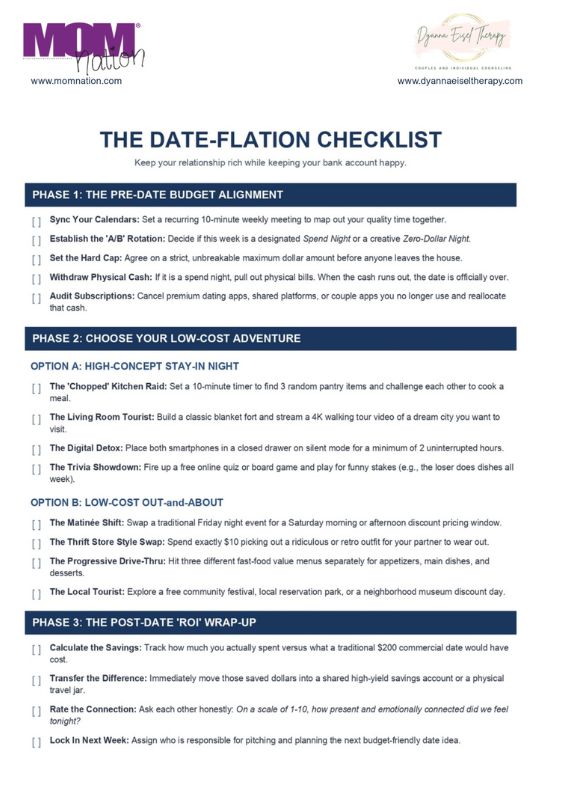
Instead of focusing only on how much you spent, one of the most important questions in the checklist is essentially: How present and emotionally connected did we feel tonight?
That's a very different measure of a successful date.
Talk About the Date Afterward
Connection doesn't have to end when the date does. Take a few minutes afterward to talk about what worked.
Did you have fun? Did you actually talk? Did you feel present with one another? Would you do it again?
You can also look at what you saved compared with a typical night out. If you planned to spend $200 but only spent $40, consider putting some of that difference toward a shared goal. That could be a future date, vacation, savings goal, or something else you're working toward together. Now saving money isn't preventing you from enjoying your relationship. It becomes something you're accomplishing as a couple.
Your Relationship Doesn't Need a Bigger Date-Night Budget
There is no perfect formula for how often couples should go out or how much they should spend. What matters is continuing to make space for each other.
Sometimes that means a great restaurant and a night away from the kids. Other times, it means putting your phones down, finding something inexpensive to do, and remembering that you actually enjoy being together.
Healthy relationships need intentional time, but intentional doesn't have to mean expensive.
As Dyanna explains throughout the conversation, the value of your connection doesn't have a dollar amount attached to it.
If dateflation has made date night feel like another bill to pay, it might be time to change what "date night" means instead of giving it up altogether.
🎧 Watch Our Love Story Conversation 🎧
Hear Katie and Dyanna's complete conversation about dateflation, financial stress, couch rotting, money differences in relationships, and how couples can create meaningful quality time without overspending.
💜 Connect With katie Halle Lambert and Dyanna Eisel💜
Dyanna Eisel: https://www.facebook.com/DyannaEiselTherapyLLC
Katie Halle Lambert: https://www.facebook.com/KatieHalleLambert
They also reference a previous Our Love Story conversation about money and relationships:
Previous Episode:
https://youtu.be/1WcLMb_V4jo?si=d0qKQrTdd74vykhV
Subscribe to MOMnation USA on YouTube and follow MOMnation Talk Radio so you don't miss future Our Love Story conversations.
